How We Grow Dutch Businesses with SEO, Speed and Ads: 3 Case Studies

Every number in this case study was measured on the live websites. Search data comes from Google Search Console for the last three months (16 August to 15 November 2026). Speed and quality scores come from Google PageSpeed Insights and Lighthouse, measured on 17 November 2026. Below we explain what we built for a dental practice in Amsterdam, an energy label specialist in Utrecht and a construction company. We cover what we changed for SEO, speed and conversion, and what the results look like today.
If you run a local business in the Netherlands and wonder why competitors appear above you on Google, these three projects show the steps that make the difference: a fast website, clear pages for every service, structured data that Google and AI search can read, and campaigns that bring patients and customers to the right page.
At a glance
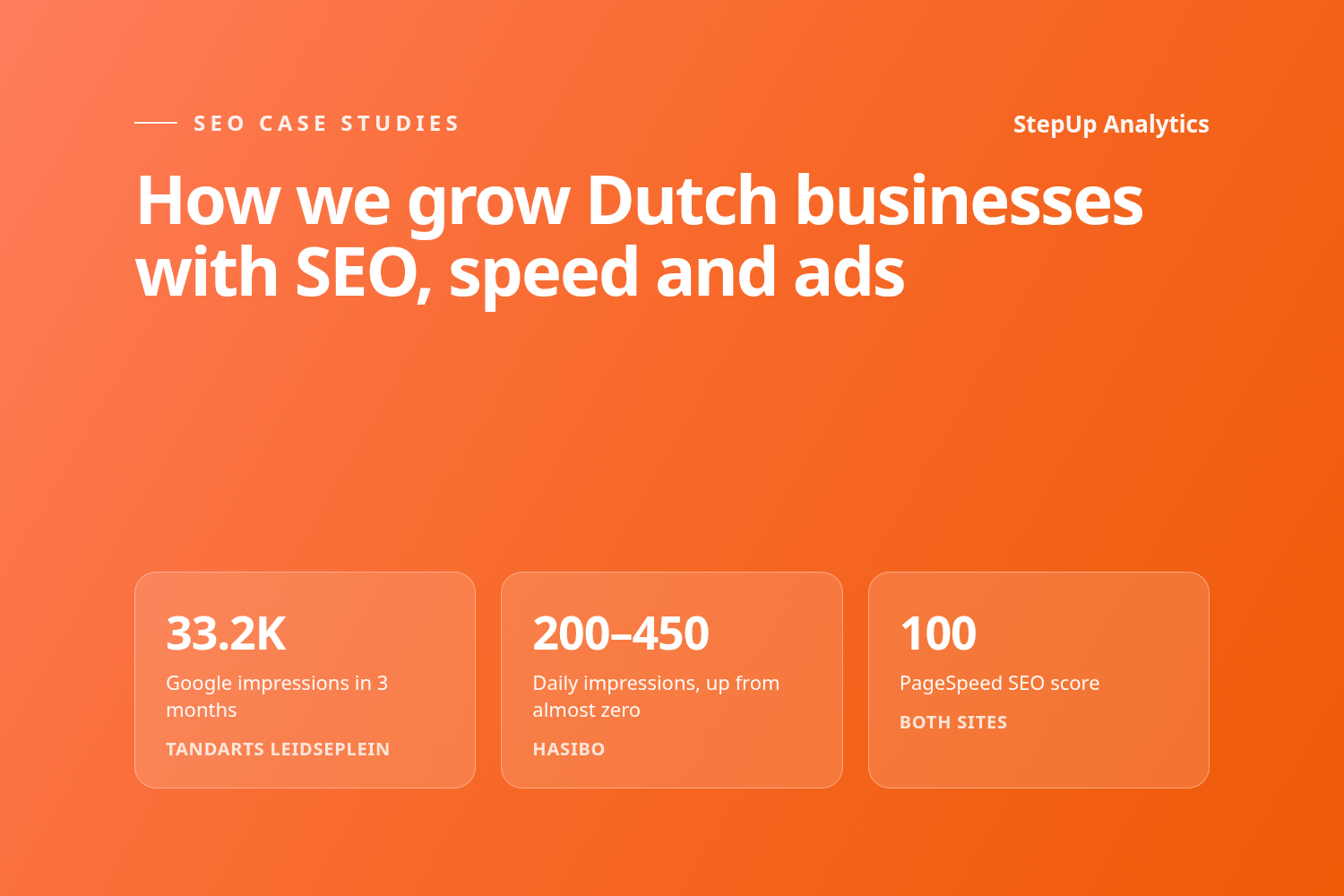
- Tandarts Leidseplein (Amsterdam): new website, SEO and GEO, Google Ads and Meta campaigns. 33,200 Google impressions and 249 organic clicks in three months, with an SEO score of 100.
- Hasibo (Utrecht): new website with online payments and public energy data, built for SEO from day one. From almost no Google visibility to 10,500 impressions, most of them in the last five weeks, with performance 92 on mobile and 100 for SEO.
- Man Bouw & Advies (construction): new website, Google Ads and an automated social media workflow that turns one topic into posts for Instagram, LinkedIn and X.
Case study 1: Tandarts Leidseplein, dental SEO in Amsterdam
The challenge
Tandarts Leidseplein is a dental practice in the centre of Amsterdam with more than 25 years of experience treating anxious patients. In a city where “tandarts Amsterdam” is one of the most competitive local searches, the practice needed a website that loads fast on a phone and explains its treatments in plain Dutch. It also needed to turn visitors into booked appointments, not just page views.
What we did
- A new website in three weeks, designed around the questions patients ask before booking: which treatments the practice offers, what an appointment costs and how the practice cares for nervous patients.
- On-page SEO for local dental searches. The homepage title “Tandarts Leidseplein | Tandartspraktijk in Amsterdam” and a meta description that names the services patients search for: spoedtandarts (emergency dentist), implantaten (implants) and bleaching.
- Dentist structured data (schema.org
Dentist) with the address, geo coordinates and the services offered, so Google, Google Maps and AI assistants understand exactly what the practice does and where it is. - GEO, or generative engine optimisation: clear, factual answers on every treatment page that AI search tools such as Google AI Overviews and ChatGPT can quote. The site scores 3 out of 3 on the Agentic Browsing check in Google PageSpeed Insights.
- Google Ads and Meta campaigns. Google Ads reaches people who are actively searching for a dentist in Amsterdam, while Meta builds awareness and trust through social content. Both send people to the treatment page that matches their search, not the homepage.
- Google Business Profile and Maps, kept up to date with treatments, opening hours and photos, so the practice can appear in the local map pack.
The results
- 33,200 impressions in Google Search in three months, around 360 times a day that the practice appears when people in and around Amsterdam search
- 249 visitors from organic search, people who found the practice on Google without a paid ad
- SEO: 100/100 on Google PageSpeed Insights
- Accessibility: 100/100, so patients of every age can use the site
- Best practices: 96/100
- Performance: 90/100 on desktop and 81/100 on mobile
- Agentic Browsing: 3/3, so AI agents can read and use the site
For a dental practice, every second of loading time on a phone matters. People looking for an emergency dentist usually search on their phone and call the first practice that loads quickly and looks trustworthy.
See the full project: Tandarts Leidseplein website and Tandarts Leidseplein digital marketing, or read the Tandarts Leidseplein case study.
Case study 2: Hasibo, a fast website for energy labels in Utrecht
The challenge
Hasibo is a certified specialist in energy labels and energy performance for homes and buildings, based in Utrecht and working across the Netherlands. People searching for an energielabel (energy label) want three things fast: the price, the next available date and proof that the adviser is certified. The website had to answer all three and let customers book and pay online.
What we did
- A new website in four weeks with an online payment gateway, so customers can order an energy label without phoning or emailing.
- Public data connected through an API, so the site can show up-to-date information without manual updates.
- Keyword-led page titles and descriptions. The homepage targets “Energielabel & Energieadvies in Utrecht” and shows the starting price, from €330, directly in the Google search result.
- Rich structured data: FAQ, breadcrumb and organisation markup plus the adviser’s professional credentials, which builds trust with Google and with AI search.
- Speed as a requirement from the first line of code: optimised images, minimal scripts and a stable layout that does not jump while loading.
The results
- From close to zero to 200–450 Google impressions a day. Until mid-October 2026 the site barely appeared in Google. Since then it shows up hundreds of times every day.
- 10,500 impressions and 43 organic clicks in three months, almost all of them since mid-October
- Performance: 92/100 on mobile and 94/100 on desktop
- Accessibility, best practices and SEO: 100/100 each
- Largest Contentful Paint: 2.3 seconds on mobile and 0.9 seconds on desktop, inside Google’s “good” range of under 2.5 seconds
- Cumulative Layout Shift: 0.003, so the page practically does not move while it loads (Google’s limit is 0.1)
See the full project: Hasibo.nl, or read how we built it in the Hasibo case study.
Case study 3: Man Bouw & Advies, website, ads and social automation
The challenge
Man Bouw & Advies B.V. is a construction and advice company that combines quality materials, expert advice and careful execution. The company needed a professional website to win trust, a way to reach people planning a building project, and a steady presence on social media without spending hours designing and posting.
What we did
- A new React website in three weeks, presenting projects and services clearly, with a fast desktop experience.
- Google Ads to reach people searching for construction and renovation services.
- An automated social media workflow in two weeks. Built with n8n and Buffer, it turns a single topic into ready-to-publish posts in several formats and publishes them on Instagram, LinkedIn and X, each adapted to the platform.
The results
- Desktop performance: 93/100, with the main content visible in 1.2 seconds
- Hours of manual design and posting replaced by one content pipeline that publishes on three platforms
See the full projects: Man Bouw & Advies website and Man Bouw & Advies social media automation.
What the search numbers mean
An impression is counted every time your website appears in Google’s search results. A click is a person who chose your result and visited your site. Impressions show how visible you are; clicks show how many people you actually reach.
For Hasibo, the curve tells the story: a new website only starts to appear in Google once it is fast, technically sound and clearly about one topic. For Tandarts Leidseplein, the steady flow of more than 300 impressions a day shows a practice that Amsterdam patients now find every day. The next step for both is to turn more of those impressions into clicks, by improving rankings for the most valuable searches and making every search result as attractive as possible.
What these three projects have in common
Different industries, one approach. These are the steps behind every result above:
- Speed first. Google uses Core Web Vitals (loading speed, responsiveness and visual stability) as a ranking signal, and visitors leave slow sites. We build to pass them on mobile, not only on desktop.
- One page per search intent. Someone searching for “spoedtandarts” or “energielabel utrecht” should land on a page about exactly that, with the price and the next step visible.
- Structured data that machines can read. Schema markup for the business type, services, FAQs and credentials helps Google show rich results and helps AI assistants quote you correctly.
- Optimised for AI search (GEO). Short, factual answers and clear headings make content easy to cite in Google AI Overviews, ChatGPT and Perplexity.
- Campaigns that land on the right page. Google Ads, Meta and social posts point to the page that matches the search, so paid clicks turn into calls and bookings.
- Measure, then improve. Search Console, Google Analytics and PageSpeed reports show what works, so every month starts from data instead of guesses.
Frequently asked questions
How long does SEO take to show results?
Technical improvements such as speed and structured data are visible in PageSpeed reports right away. Rankings usually start to move within four to twelve weeks, depending on competition. Local searches such as “tandarts amsterdam” are more competitive than niche searches and take longer.
How do you measure SEO results?
We use Google Search Console for impressions, clicks and the searches people use to find you. We use Google Analytics for what visitors do on the site, such as calls, forms and bookings, and PageSpeed Insights for speed and technical quality. You get access to the same data, so you can check every number yourself.
What is a good PageSpeed score?
Google rates 90 to 100 as good, 50 to 89 as needs improvement and below 50 as poor. Mobile scores are almost always lower than desktop because the test simulates a mid-range phone on a slower connection. The scores that count for ranking are Core Web Vitals measured from real visitors.
What is GEO and do I need it?
GEO, or generative engine optimisation, makes your website easy for AI search tools to understand and quote. More and more people ask ChatGPT or Google’s AI Overview which dentist or energy adviser to choose. Clear answers, structured data and a fast, accessible site increase the chance that you are the business they recommend.
Do you also run Google Ads and social media?
Yes. As the Tandarts Leidseplein and Man Bouw & Advies projects show, we combine SEO with Google Ads, Meta campaigns and social media automation, so you get customers from search while your organic rankings grow.
Want results like these for your business?
Test your own website for free with our website performance test. Run a dental practice? Get a free practice scan. You can also see how we help businesses in Amsterdam and Utrecht, read about local SEO in Amsterdam or Google Ads in Amsterdam, or book a free strategy call and we will tell you exactly what to improve first.
Tell us about your project
Whether you're planning a redesign or starting fresh, we're here to help you align strategy, design, and performance. Get in touch for a free intro call. No pressure, just a focused conversation.
For more information write to us at [email protected]