Beyond the Sales Funnel: Building an End-to-End Business System with GoHighLevel

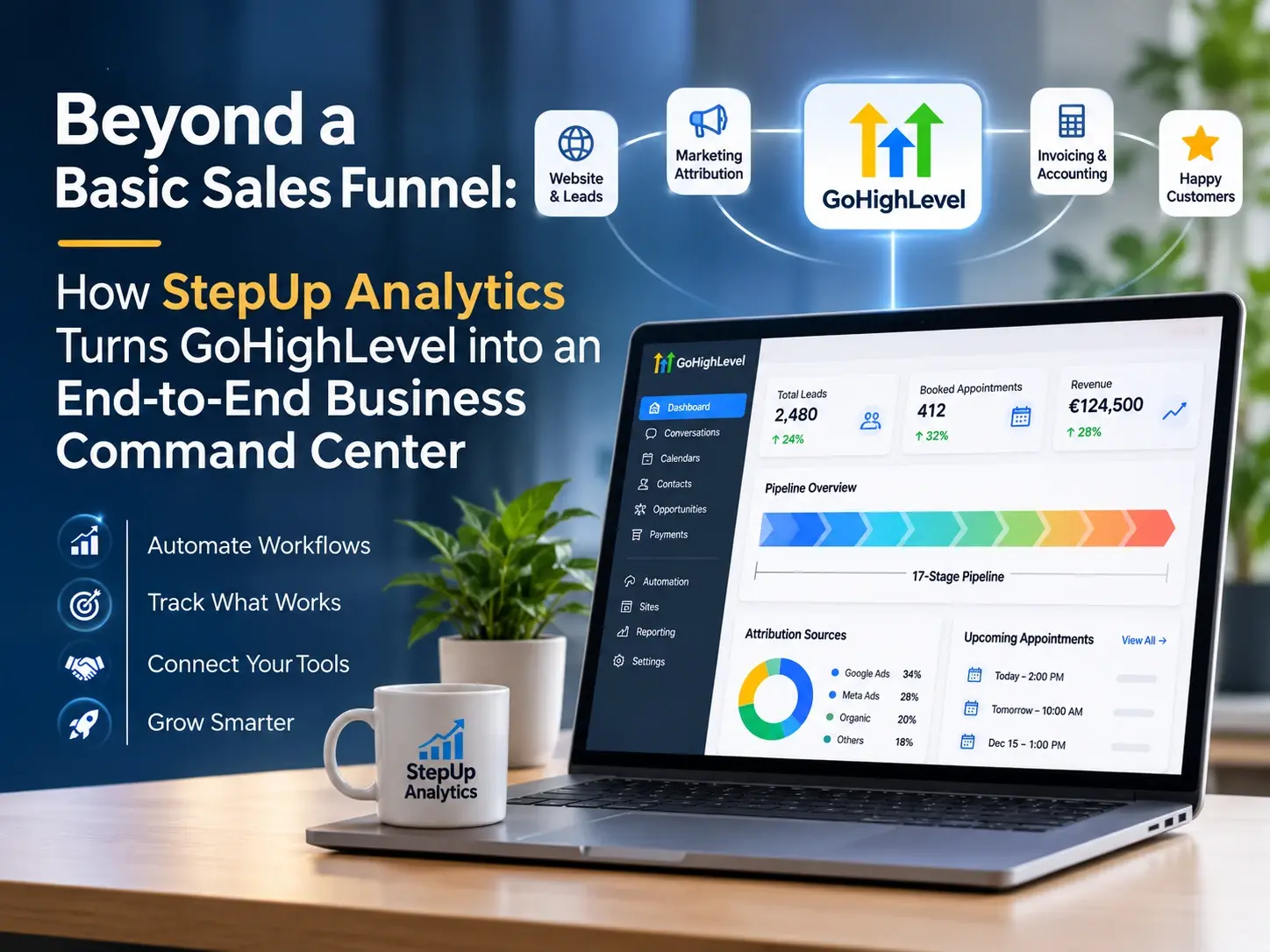
Most businesses start using GoHighLevel (GHL) to manage leads, track sales opportunities, and automate follow-ups. That is a good starting point, but it often leaves a much bigger opportunity untapped.
The real operational challenges usually begin after a lead enters the CRM. Website enquiries need to reach the right people. Marketing sources need to be tracked. Appointments need to be coordinated. Customers need timely updates. Estimates and invoices need to reach accounting software. And everyone needs a reliable way to know what is happening with each customer.
Without proper integration, these processes remain scattered across different tools. Teams end up copying information between applications, creating duplicate records, checking payment statuses manually, and updating CRM pipelines themselves.
At StepUp Analytics, we approach GoHighLevel as more than a place to manage sales activity. We look at the entire customer journey and identify where data, communication, and day-to-day operations can work together through automation.
A good example is our implementation for Energielabel-Oké, a Dutch energy label assessment provider. The project involved connecting its website, marketing attribution, inspection workflows, customer communication, GoHighLevel CRM, and Moneybird accounting software.
Here is how the system works and some of the practical decisions that went into building it.
1. Designing a Pipeline Around the Actual Business Process
A typical sales pipeline might have four or five stages: New Lead, Contacted, Proposal Sent, Won, and Lost.
That works for tracking straightforward sales, but it does not tell the whole story for a service business where closing a deal is only the beginning. An inspection still needs to be scheduled, completed, processed, and followed by the delivery of a certificate and payment.
For Energielabel-Oké, we built a 17-stage operational pipeline that follows each job from the first enquiry through to completion and archiving.
The important distinction is that the pipeline represents what is actually happening in the business, not just where a lead stands in the sales process. It also includes exception stages such as No Response, Appointment Cancelled, Estimate Rejected, and Closed Lost. This makes it easier to understand where jobs are getting stuck and keeps reporting meaningful.
We also made a deliberate distinction between actions that require a person and updates that the system can handle automatically.
- Human-controlled steps: Team members handle activities that require judgment, such as qualifying an enquiry, confirming an inspection, authorising an estimate or invoice, completing the on-site assessment, and delivering the final certificate.
- Automated updates: When an estimate is sent or accepted, or an invoice is issued or paid through Moneybird, the relevant opportunity stage is updated automatically in GoHighLevel.
This separation matters. Automation should reduce repetitive administrative work, not take control of decisions that still need a human. The team can focus on the work itself while the CRM stays up to date in the background.
2. Keeping Lead Capture Clean and Preventing Duplicate Records
Duplicate contacts and opportunities might seem like a minor CRM problem at first. Over time, though, they create confusion. Two records may exist for the same customer, conversations get split across profiles, and sales representatives are left wondering which opportunity is the correct one.
We addressed this at the point where customer data enters the system.
When someone submits an appointment or quote request through the Energielabel-Oké website, the lead-capture process checks GoHighLevel before creating anything new.
Here is what happens:
- Existing contact detection: The system searches for a matching contact using the customer's email address and phone number. When a match is found, it reuses the existing profile instead of creating another one. New information, including details such as a Dutch Chamber of Commerce (KVK) number, can be added to that profile.
- Duplicate submission handling: Customers sometimes submit a form and then submit it again a few minutes later because they forgot something or want to request an additional service. We implemented a one-hour resubmission window. When a recent submission is detected, the system updates the existing opportunity and adds a timestamped note containing the new information, rather than creating another deal.
- Separate recruitment routing: Not every website enquiry belongs in the sales pipeline. Job applications are routed directly to management through tracked email, keeping recruitment enquiries separate from potential customer opportunities.
The goal is straightforward: every customer should have a clear record, and every enquiry should reach the right place.
3. Understanding Which Marketing Channels Generate Leads
Tracking leads is useful. Understanding where those leads came from, and eventually which marketing activities generate business, is much more valuable.
For this project, we built a multi-channel attribution system that captures marketing information across 12+ platforms, including Google Ads, Meta (Facebook and Instagram), Microsoft/Bing, LinkedIn, TikTok, WhatsApp, and email newsletters.
The system records 21 structured tracking fields on each GoHighLevel opportunity. These fields provide a consistent way to understand the source, campaign, and other available attribution details associated with an enquiry.
One challenge with marketing attribution is that tracking information is not always consistent. Campaign names may use different naming conventions, UTM parameters may be missing, and visitors may arrive through links containing advertising click identifiers.
To handle this, the attribution engine standardises campaign information and uses available click IDs and referral data to identify the traffic source where possible.
There is also an important privacy consideration. Collecting attribution data should not come at the expense of visitor consent. We configured the tracking process so that marketing tracking information is stored and passed to GoHighLevel only after the visitor grants the required cookie consent.
This gives the business a more useful picture of its marketing activity while taking European GDPR and ePrivacy requirements into account.
4. Coordinating Customer Communication Across Email and WhatsApp
For businesses that rely on scheduled site visits, communication is part of the service itself. A customer who does not know what to prepare, when an inspector is arriving, or what happens next is more likely to miss an appointment or contact the business for clarification.
We used GoHighLevel workflows to automate communication at important points in the customer journey.
As soon as a new lead enters the CRM, the customer receives an acknowledgement, while an internal task reminds the team to follow up within the expected response window.
Once an inspection is scheduled, the system starts an email and WhatsApp reminder sequence:
- 48 hours before the appointment: The customer receives preparation instructions, such as ensuring access to the meter cupboard and attic and having relevant heating documentation available.
- 24 hours before: A reminder confirms the inspector's expected arrival window and provides the relevant contact details.
- 2 hours before: The customer receives a final notification that the inspector is on the way.
A detail worth paying attention to here is how the system handles cancellations and rescheduling.
Sending reminders is easy. Making sure they are sent at the right time, and not sent when they are no longer relevant, requires more careful workflow design.
Before sending a reminder, the automation checks the current appointment status. When an appointment is rescheduled, the reminder schedule adjusts to the new booking. When it is cancelled, the remaining reminders stop.
Communication also continues after the inspection. Customers receive updates when the on-site assessment is complete, when their energy label is ready, and when their payment has been confirmed.
Once the final certificate is delivered, the system sends the customer a direct Google Review link. This creates a natural opportunity to collect feedback while the completed service is still fresh in the customer's mind.
5. Connecting GoHighLevel with Moneybird for Reliable Billing
Accounting is one of the areas where disconnected software creates unnecessary administrative work. When a CRM and accounting platform operate independently, employees often have to enter customer information twice, recreate estimates, and manually check whether invoices have been paid.
For Energielabel-Oké, we built a two-way integration between GoHighLevel and Moneybird, covering estimate creation, invoice preparation, and payment status updates.
The integration follows a controlled process rather than automatically sending every financial document without review.
Creating estimates and invoices from GoHighLevel
When a team member moves an opportunity to Send Estimate or Send Invoice, the integration finds or creates the corresponding customer in Moneybird and generates a draft document.
This removes the need to re-enter customer details and manually recreate the document in another application.
Giving the accounting team the context they need
Creating a document is only part of the process. The person reviewing it also needs to understand the work being billed.
That is why the integration attaches relevant GoHighLevel notes to the draft estimate and creates a review task for the accounting team. They can verify the services, pricing, and VAT before sending the document to the customer.
Preventing out-of-order billing
We also added a billing safeguard: an invoice cannot be drafted through the workflow unless the corresponding estimate has already been accepted.
This helps prevent invoices from being generated before the customer has approved the underlying estimate.
Synchronising payment information
The integration also handles the return flow from Moneybird to GoHighLevel.
When a customer pays through iDEAL, SEPA transfer, or a bank payment link, Moneybird notifies the integration. GoHighLevel then updates the opportunity to Payment Received and adjusts its value to reflect the exact amount paid.
As a result, the CRM does not just track the initial sale. It can also reflect what has actually happened financially.
What This Approach Changes About GoHighLevel
The Energielabel-Oké implementation illustrates an important distinction: configuring a CRM and engineering a business system around it are two different things.
GoHighLevel provides useful building blocks for managing contacts, opportunities, communication, and workflows. But those features become significantly more useful when they are connected to the systems and processes a business already depends on.
In this implementation, that meant:
- A 17-stage pipeline that reflects the complete service lifecycle.
- Lead capture that reuses existing contacts and prevents duplicate opportunities.
- Marketing attribution across more than 12 channels.
- Automated email and WhatsApp communication tied to appointment status.
- A two-way GoHighLevel and Moneybird integration for estimates, invoices, and payments.
- Clear separation between decisions handled by employees and repetitive tasks handled by automation.
None of these components works in isolation. The value comes from how they exchange information and keep the entire operation aligned.
Building a GoHighLevel Setup Around How Your Business Actually Works
There is no single CRM configuration that makes sense for every business. A company managing online enquiries has different requirements from one coordinating inspections, field teams, customer documents, and accounting.
That is why we start with the operational process rather than a pre-built template. We look at where information enters the business, who needs it, what decisions are made along the way, and which tasks can be handled reliably through automation.
At StepUp Analytics, we work on custom GoHighLevel implementations that bring these processes together, including advanced workflows, multi-channel attribution, website integrations, and connections with external platforms such as Moneybird.
The objective is not to add automation everywhere. It is to remove unnecessary manual work, improve visibility, and make sure the systems a business relies on stay in sync.
For businesses exploring what GoHighLevel can do beyond basic lead management, that is where the more interesting possibilities begin.
Klaar om uw bedrijf te laten groeien?
Bekijk onze specialistische diensten en ontdek wat StepUp Analytics voor u kan betekenen.
AI & Automatisering Oplossingen
Automatiseer uw workflows en klantenservice met slimme AI.
Bekijk Dienst
Vertel ons over uw project
Of u nu een redesign plant of helemaal opnieuw begint, wij helpen u strategie, design en prestaties op elkaar af te stemmen. Neem contact op voor een gratis kennismakingsgesprek. Geen druk, gewoon een gericht gesprek.
Voor meer informatie kunt u ons mailen via [email protected]